
Lexington · Commercial Real Estate
Winchester Road Corridor Commercial Property
Two interstates, one corridor — where Lexington’s distribution economy actually lives.
Winchester Road — US 60 east — is Lexington’s working corridor: industrial, flex, and service-commercial property running from New Circle Road out to Interstate 75 at Exit 110, immediately south of where I-75 meets I-64. That two-interstate junction is the corridor’s defining asset, putting north–south and east–west distribution on the same ramp system. Buildings here are judged on clear height, docks, power, and truck access. Current availability and pricing live in The Corridor Report.
What is the character of the Winchester Road corridor?
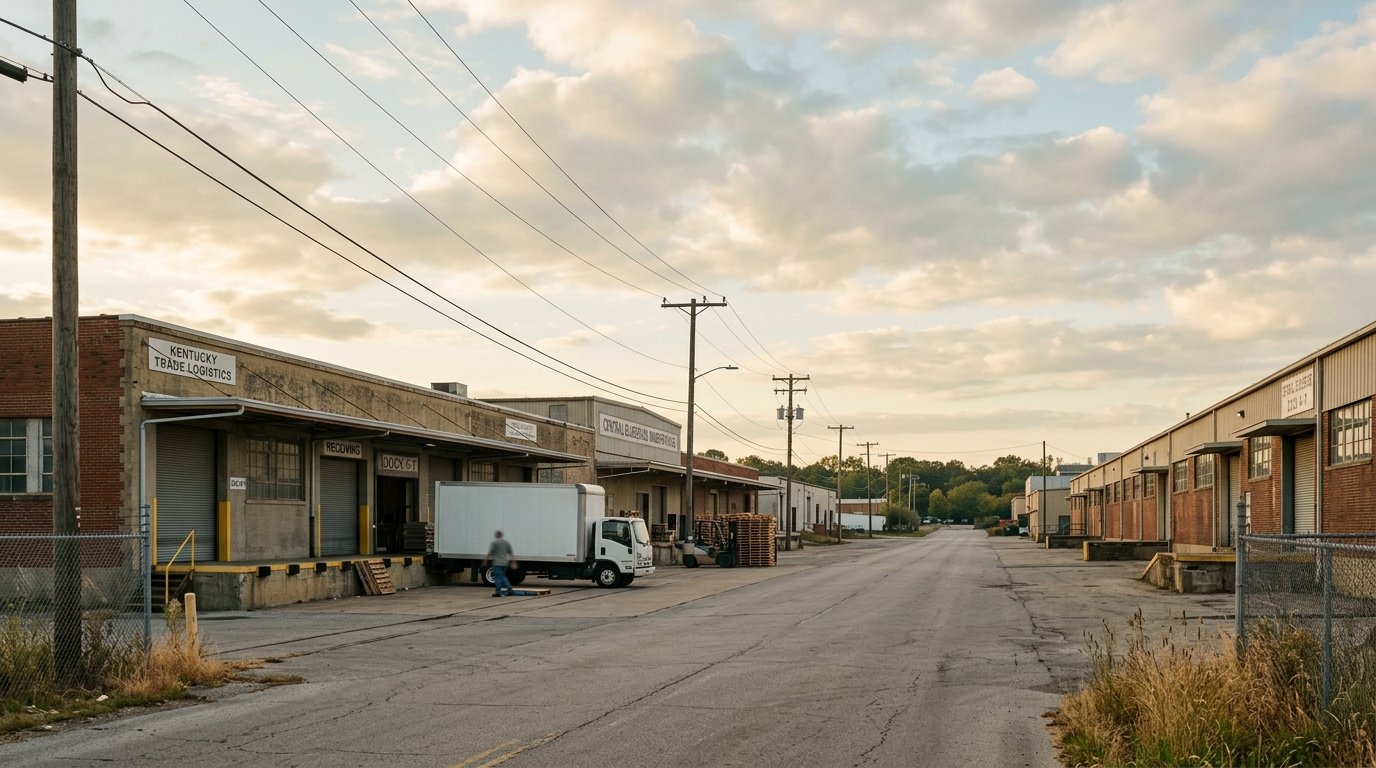
Where Nicholasville Road sells to consumers, Winchester Road ships to them. The stretch of US 60 between New Circle Road and I-75 carries business parks, warehouses, contractor yards, flex buildings, and the service commercial that supports them — with Hamburg’s retail district just north across the interchange. It is not a corridor of storefronts; it is a corridor of docks, yards, and power service. For industrial and warehouse users, it is usually the first Lexington submarket worth touring, because this is where the inventory actually is.
Why does the I-75 / I-64 interchange matter so much?
Winchester Road meets I-75 at Exit 110, one exit south of the junction where I-64 splits east toward Winchester and Ashland. That geometry gives the corridor same-ramp access to both of Kentucky’s primary freight axes: I-75 running north–south between Cincinnati and Knoxville, and I-64 running east–west between Louisville and West Virginia. For a distribution or service business, that is the whole argument — trucks reach two interstates without crossing town. Sites closer to the interchange price that convenience in; sites nearer New Circle trade access for basis.
Two interstates, one corridor — where Lexington’s distribution economy actually lives.
What is flex space, and who uses it here?
Flex is the corridor’s workhorse format: a building that combines office frontage with warehouse or shop space behind it, divisible into units. Contractors, wholesalers, showroom-plus-warehouse retailers, light assembly, labs, and service companies all live in flex because it lets a small business keep its office, inventory, and crew under one roof. When evaluating a flex unit, the details that matter are the office-to-warehouse ratio, drive-in versus dock-high doors, ceiling clear height, and three-phase power. See the industrial guide for how each drives value.
What should industrial buyers verify on this corridor?
Industrial due diligence is unforgiving of assumptions. Verify clear height under the joists, dock and drive-in door counts, truck court depth and turning room, power capacity, sprinkler classification, and floor condition — each one can disqualify a building for a specific user. Confirm zoning with LFUCG; much of the corridor carries industrial classifications such as Light Industrial (I-1), but classifications vary parcel to parcel, so check the zoning guide and the official map rather than assuming. Then run full due diligence, including environmental history — working corridors have working pasts, and a Phase I assessment is standard practice here.
Where do industrial pricing and availability live?
Industrial is the quietest of Lexington’s property types — buildings often change hands between operators before a sign ever goes up, and published listings understate the real market. I track corridor activity, asking-price movement, and the development pipeline in The Corridor Report, and I maintain owner relationships along the corridor for off-market matches. If you have a specific requirement — size, doors, power — tell me and I will canvass it directly.
Common Questions
Is Winchester Road only industrial?
No — industrial and flex set the character, but the corridor also carries service commercial, auto uses, offices attached to operations, and land positions near the interchange. What you will not find much of is conventional retail frontage; that demand concentrates in Hamburg just north and on the consumer corridors. Users who need customer traffic should compare carefully before choosing the corridor for its price alone.
Can a small business find space here, or is it all big-box distribution?
Small users are well served. Flex parks along the corridor divide into modest units suited to contractors, trades, and service companies, and smaller freestanding warehouses trade regularly. The constraint is that good small industrial rarely stays available long and often trades off-market — which is exactly the case for requesting the curated list rather than watching public listings.
What zoning applies along Winchester Road?
Much of the corridor carries industrial and commercial classifications under the LFUCG Zoning Ordinance — Light Industrial (I-1) among them — but zoning is parcel-specific and I am not a land-use attorney. Confirm the classification and permitted uses for any specific property with LFUCG, and involve a land-use professional if your use is unusual. My zoning guide explains the framework in plain terms. Parcel-level classifications and assessments are searchable in Fayette County property records.
Hamburg’s retail district sits directly across the interchange, and the industrial guide covers how to evaluate the buildings themselves.
Marcos Gil, REALTOR® · Keller Williams Commonwealth · Commercial real estate across Lexington and Central Kentucky · Also owner of Central Property Services and publisher of Invest in the Gorge — any recommendation involving my other businesses is disclosed in writing.
Request the Commercial List
Last updated: August 14, 2026