
Lexington · Commercial Real Estate
Downtown Lexington Commercial Property
Where Lexington’s office market, events economy, and history occupy the same blocks.
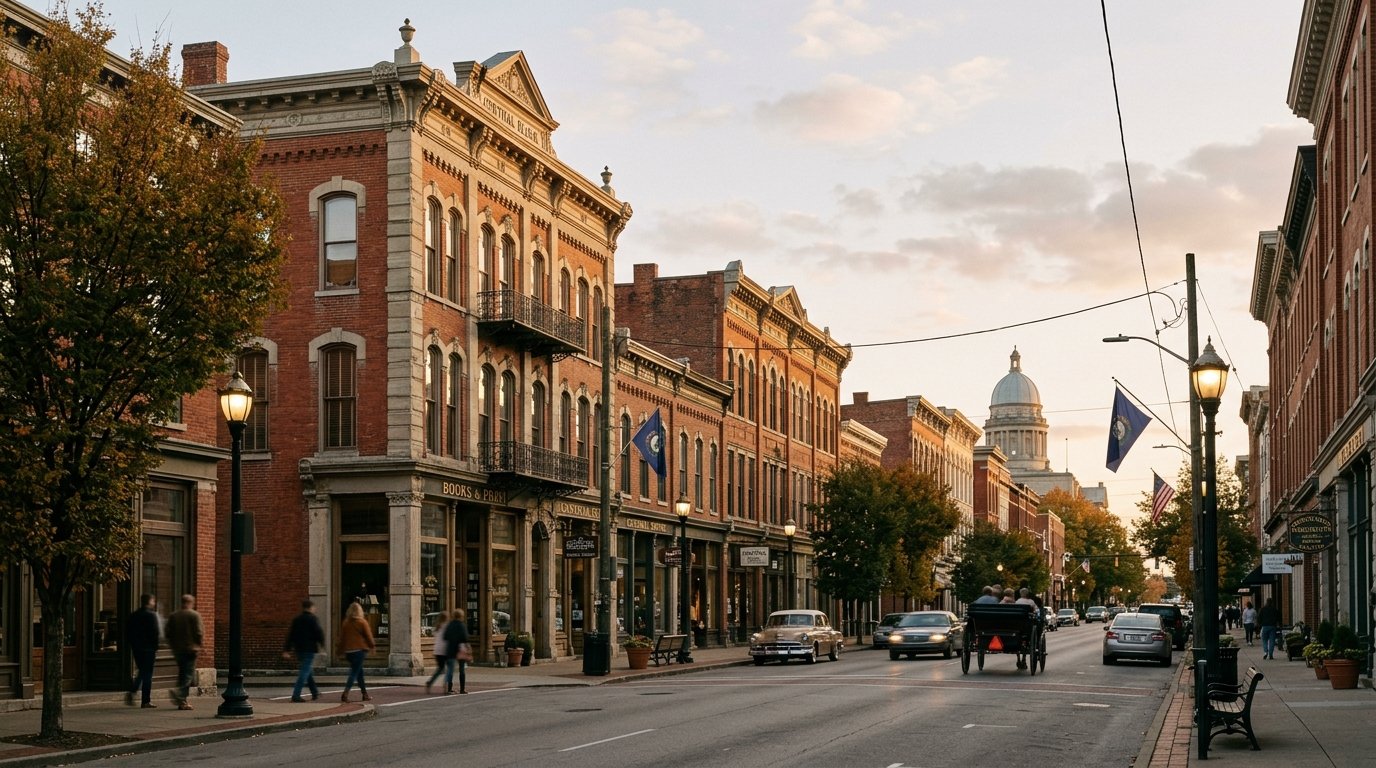
Downtown Lexington’s commercial core runs on two engines: daytime office demand and an events economy anchored by Rupp Arena at Central Bank Center. Street-level retail and restaurants trade on walkability, while upper floors mix office, residential conversion, and hospitality. Parking is structured rather than surface, and much of the building stock is historic — which shapes renovation budgets and timelines. For current activity block by block, request The Corridor Report.
What kind of commercial property defines downtown Lexington?
The central business district is a compact mix: multi-story office buildings along Main and Vine, street-level retail and restaurants beneath them, and a growing share of upper-floor residential conversion. Most of the core sits in the Downtown Business (B-2) zone family under the LFUCG Zoning Ordinance — including the Downtown Frame (B-2A) and Lexington Center (B-2B) zones — which permits higher intensity and mixed use than suburban districts. The practical effect: downtown deals are rarely single-use, and underwriting usually has to account for more than one income stream.
How does the events economy shape street-level value?
Rupp Arena at Central Bank Center — home floor of University of Kentucky men’s basketball — sits inside the Central Bank Center convention complex at the west end of downtown. Game nights, concerts, and convention bookings push episodic foot traffic through the surrounding blocks, which is why restaurant and bar space near the venue behaves differently from retail elsewhere in the city. The honest caveat: event traffic is spiky, not steady. An operator who needs consistent weekday lunch business is underwriting a different downtown than one built for Friday nights.
Is downtown walkable enough to matter for tenants?
Increasingly, yes. Town Branch Commons — the linear park and trail opened in 2022 along the buried path of Town Branch Creek — threads roughly two and a half miles through downtown, largely along Vine Street, and connects the Town Branch Trail to the Legacy Trail. For office tenants competing on recruitment, a walkable block with trail access, coffee, and lunch options is a leasing argument, not a landscaping detail. When touring space, walk the actual block at noon on a weekday — the variation from one corner to the next is real.
Where Lexington’s office market, events economy, and history occupy the same blocks.
What are the parking realities downtown?
Downtown parking is structured — garages and surface lots, some public, some private — rather than the field of striped asphalt suburban tenants expect. Office leases often bundle a negotiated number of garage spaces; retail depends on street parking and nearby decks. Before committing, verify exactly which spaces convey, at what cost, and for how long — parking rights are a contract term, not an assumption. It is one of the first things I flag in due diligence on any downtown deal.
What should buyers know about historic buildings?
Much of downtown’s character comes from buildings that predate modern construction codes. That is the appeal and the cost: renovations can trigger accessibility, sprinkler, and structural upgrades, and facade or elevator work in an older building rarely comes in cheap. None of this is a reason to avoid downtown — some of the corridor’s most durable assets are hundred-year-old buildings with modern systems already installed. It is a reason to budget carefully, engage a contractor early, and price the work into your offer. Start with how buying works here. Historic overlay and zoning details are available from the LFUCG Division of Planning.
How do I track what is actually happening downtown?
Asking prices, absorption, and the conversion pipeline move faster than any static webpage should pretend to track — so I keep current figures in The Corridor Report instead of publishing numbers that would quietly go stale. If you are watching a specific block, tell me which one and I will include it in what I send you.
Common Questions
Is downtown office worth considering right now?
It depends on the building and the use. Smaller floor plates with parking solved and street presence lease differently than large single-tenant blocks. Downtown rewards operators who benefit from walkability, events traffic, or proximity to courts and government — and punishes uses that need cheap surface parking. Request The Corridor Report for current activity before forming a view.
Do downtown buildings cost more to renovate?
Often, yes. Older structures can require code, accessibility, and systems upgrades that newer suburban shells do not. The offsetting factor is acquisition basis and character that new construction cannot replicate. Get a contractor’s walkthrough before you write an offer, and treat the renovation estimate as part of the price.
What zoning applies in downtown Lexington?
The core is primarily the Downtown Business (B-2) zone, with the Downtown Frame (B-2A) and Lexington Center (B-2B) zones nearby, under the LFUCG Zoning Ordinance. These allow high-intensity mixed use, but permitted uses vary by zone — confirm the exact zoning and any overlay for a specific parcel with LFUCG before you commit. See the zoning guide.
Compare downtown with the Hamburg corridor east of town, or the Nicholasville Road retail spine to the south.
Marcos Gil, REALTOR® · Keller Williams Commonwealth · Commercial real estate across Lexington and Central Kentucky · Also owner of Central Property Services and publisher of Invest in the Gorge — any recommendation involving my other businesses is disclosed in writing.
Request the Commercial List
Last updated: August 14, 2026