Marcos Gil, REALTOR® · Keller Williams Commonwealth

Corridor Notes

  • Lexington’s Water Quality Management Fee: What Commercial Buyers Pay

    Corridor Notes · Operating Costs

    Lexington’s water quality management fee is the operating cost that almost never appears in a commercial listing, and on a paved site it is not small. The fee is billed per 2,500 square feet of impervious surface, at $6.18 per Equivalent Residential Unit per month as of July 1, 2026, a rate published by the Lexington-Fayette Urban County Government. A single-family house pays one unit. A commercial parcel pays as many units as its roof, parking lot, driveway and sidewalks add up to. You can compute the number from a site plan before you write the offer.

    What is Lexington’s water quality management fee?

    It is a monthly stormwater charge on every developed parcel in Fayette County, billed through LEXserv, funding the city’s stormwater system rather than sanitary sewer treatment.

    The Lexington-Fayette Urban County Council approved the fee in January 2010. It was not a discretionary revenue idea: the city states the fee was established as a requirement of its Consent Decree with the U.S. Environmental Protection Agency and the Commonwealth of Kentucky over Federal Clean Water Act violations. That origin matters to a buyer, because a fee created to satisfy a federal enforcement obligation is not one a city negotiates away. The U.S. Environmental Protection Agency runs the federal enforcement program aimed at returning facilities to compliance with Clean Water Act regulations, and the city’s own terms are codified in the Code of Ordinances at Sections 16-401 through 16-410.

    The fee is adjusted every July 1 to track the Consumer Price Index, as required by ordinance. It moved from $5.95 to $6.18 per unit for the fiscal year running July 1, 2026 through June 30, 2027. Underwrite it as an escalating expense, not a fixed one.

    How is the fee calculated on a commercial parcel?

    Impervious square footage divided by 2,500, rounded to the nearest unit, multiplied by the monthly rate. Residential and farm parcels are capped at exactly one unit.

    The city splits parcels into two classes, and the split is where the money is:

    Parcel classWhat it coversHow it is billed
    Class ASingle-family residential parcels and farm parcelsOne Equivalent Residential Unit — one and only one, regardless of acreage
    Class BEverything else, including commercial, industrial and apartment complexesImpervious square feet ÷ 2,500, rounded to the nearest unit
    Parcel classes and billing method as published by LFUCG. Impervious surfaces include roofs, parking lots, driveways and sidewalks.

    Two mechanics catch buyers out. First, billing runs on a premise number assigned by Kentucky American Water, not on the parcel identification number you are used to reading, and the relationship between premises and parcels can be many-to-one. Second, a parcel that receives no water service is not automatically outside the fee — the city creates what it calls a “non-mutual” premise and bills the stormwater fee there. A vacant, unserviced, fully paved lot can still generate a monthly bill.

    What does that actually cost on a real site?

    Run the arithmetic on the published rate. A one-acre retail pad at 70 percent impervious coverage bills twelve units, or $889.92 a year.

    An acre is 43,560 square feet. The rest is division. These are calculations from the published $6.18 rate, not quotes for any specific parcel — your own number depends on the impervious area the city has on file for that premise.

    SiteImpervious coverageImpervious sq ftUnits billedPer monthPer year
    1 acre70%30,49212$74.16$889.92
    2 acres80%69,69628$173.04$2,076.48
    5 acres85%185,13074$457.32$5,487.84
    Arithmetic at $6.18 per unit per month, the rate LFUCG publishes for July 1, 2026 – June 30, 2027.

    Then capitalize it. Divide the annual figure by whatever rate your deal underwrites at — that is the value the expense removes. At 7 percent, purely as an illustration and not as a market quotation, the five-acre line above is roughly $78,400 of value sitting inside a line item most buyers never price.

    The water quality fee is also not the only LEXserv line on a commercial building. LEXserv publishes a separate non-residential sanitary sewer rate of $11.62 for the first unit of 0–100 cubic feet and $8.77 for each additional unit as of July 1, 2026, plus a $4.50 monthly landfill fee where the city collects waste. Both the sewer and stormwater fees index to CPI on the same July 1 schedule.

    A farm parcel pays one unit forever. Pave it and the same ground can bill a hundred. The rezoning that creates the value also creates the expense.

    Why does the fee jump after a farm parcel is developed?

    Because development moves the parcel from Class A to Class B, and Class B is metered on pavement. The one-unit cap that protected it disappears.

    This is the part worth carrying into an underwriting model. A ten-acre farm parcel in Fayette County is Class A: one unit, $6.18 a month, $74.16 a year, whether it is ten acres or a hundred. Develop that same ten acres to 60 percent impervious coverage and it becomes Class B — 261,360 square feet of impervious surface, 105 units, $648.90 a month, $7,786.80 a year. The identical dirt bills 105 times what it billed as farmland.

    That matters most on exactly the parcels this series has been working through. Land inside the Lexington urban service boundary is the land that can be developed, which makes it the land that will make the Class A to Class B jump. A pro forma built on the seller’s current utility bills is reading a Class A number for a Class B future. If you are also modelling entitlement time, the certificate of occupancy milestone is a defensible place to start the stormwater expense in the model, since that is the point at which the impervious surface is finished and the building is occupied.

    The design lever is real, too. Because the fee is metered on impervious square footage rather than on acreage or assessed value, pervious paving, reduced parking counts and green infrastructure reduce the bill permanently rather than once. The city also reports that a portion of the fee it collects funds its Stormwater Quality Projects Incentive Grant Program, which it describes as available where a commercial property faces stormwater problems, across Class A neighborhood, Class B education and Class B infrastructure grant categories.

    What if the number on your parcel looks wrong?

    Do not file an appeal first. The city routes impervious-area miscalculations and property-line errors through customer service, and reserves the appeal for challenges to the ordinance itself.

    LFUCG is explicit that the appeals process “is not the first step” for an owner disputing the calculation. Impervious area calculations, possible property line errors and similar fee-calculation issues go through the customer service process, reachable at LexCall 311 or (859) 425-2255. Challenges to the ordinance, requests for exemptions and questions about the legality of the fee are what the formal appeals process exists for. Sending a calculation error into the appeals track is how a correctable billing mistake becomes a long one.

    One date worth putting in a calendar: the city lists a Water Quality Fees Board meeting for October 8, 2026 on its public calendar. The rate that lands on your operating statement next July is set in rooms like that one, in public, and almost no commercial owner attends.

    What I check before an offer goes in

    When I am working a commercial deal in Fayette County, the stormwater line is one of the few operating costs a buyer can compute independently before ever asking the seller for a bill — and I would rather compute it than accept it. The site plan gives me building footprint, parking and drive aisles; that is the impervious number, near enough, and the rest is division. What I am really looking for is the gap between what the seller’s statement shows and what the published formula produces. A gap in the buyer’s favor often means the city’s impervious data is stale and a correction is coming later. A gap the other way is worth a phone call to LexCall before closing rather than after. Neither is a deal-breaker on its own. Both are cheaper to find in due diligence than in year one.

    Frequently asked questions

    Is the water quality management fee the same as the sanitary sewer fee?

    No. They are separate lines on the same LEXserv bill. The water quality management fee funds the stormwater system and is billed on impervious surface area. The sanitary sewer fee funds wastewater treatment and is billed on water consumption, at a published non-residential rate of $11.62 for the first 0–100 cubic feet and $8.77 per additional unit as of July 1, 2026.

    Does an undeveloped or vacant commercial lot pay the fee?

    The fee applies to developed parcels, and the city notes that a premise does not have to be receiving water service from Kentucky American Water to be assessed — it creates a “non-mutual” premise and bills the stormwater fee there. Exceptions are set out in the fee ordinance, so confirm the specific parcel with the city rather than assuming either way.

    Can reducing pavement lower the bill?

    The published formula is impervious square feet divided by 2,500, rounded to the nearest unit, so fewer impervious square feet means fewer billed units, and the reduction recurs every month rather than once. Confirm how the city will treat any specific surface before counting the savings in a pro forma.

    Last updated: September 1, 2026

    By Marcos Gil, REALTOR® — Keller Williams Commonwealth · KY Real Estate License No. 296259 · Call or text (859) 310-1209.

    Disclosure: I also own Central Property Services and publish investinthegorge.com and marcosgilrealty.com. This article is general information about a published municipal fee, not legal, tax or lending advice — I am your agent, not your lender.
  • Conditional Use Permit Lexington KY: What Buyers Inherit

    Corridor Notes · Zoning & Entitlements

    A conditional use permit in Lexington, KY is not a one-time approval you buy along with the building. Under Kentucky law it is a standing obligation attached to the use of the land, reviewed at least once a year, and revocable if the conditions on it are not being met. If you are buying a commercial property whose use depends on one, that permit is a due-diligence item with teeth — and most purchase contracts never mention it.

    Nearly everything published about Lexington’s Board of Adjustment is written for applicants — people seeking a permit. Very little of it is written for the person on the other side of the transaction: the buyer acquiring a property that already operates under one. This is that read.

    What is a conditional use permit in Lexington, KY?

    It is a permit from the Board of Adjustment allowing a use the zoning regulations specifically name as conditional in that zone — suitable only in certain locations, and only if stated conditions are met.

    That is the whole architecture of it. Kentucky’s zoning statute gives a board of adjustment the power to hear and decide these applications “to allow the proper integration into the community of uses which are specifically named in the zoning regulations which may be suitable only in specific locations in the zone only if certain conditions are met.” The board may approve, modify, or deny an application, and when it approves it may attach conditions — including time limits, prerequisites, and, critically, “conditions of a continuing nature.”

    The statutory language quoted here is KRS 100.237, published by the Kentucky Legislative Research Commission, which records the current version as effective January 1, 2015.

    A continuing condition is the part that survives the closing. Hours of operation, screening, buffering, parking configuration, lighting, access points — whatever the board wrote into the permit is still binding on the property after you own it, and you did not get a vote on it.

    How often is a conditional use permit reviewed?

    At least once a year. KRS 100.237(4) requires the administrative official to review every conditional use permit annually, except those whose conditions have been permanently satisfied.

    The same subsection gives that official the power to inspect the land or structure to confirm the landowner is complying. If they find non-compliance, the statute sets out a specific sequence: a written report to the chairman of the board of adjustment, a copy furnished to the landowner at the same time, a hearing “within a reasonable time,” and at least one week’s notice of that hearing. If the board finds the report true and finds the landowner took no steps to comply between the date of the report and the date of the hearing, it may authorise the administrative official to revoke the permit and take legal action to terminate the activity on the land.

    Read that as a buyer rather than as a lawyer. The annual review does not care who signed the deed. If the property is out of compliance when the review lands, the owner on that date answers for it.

    You are not buying a permit. You are assuming someone else’s compliance record — and the first annual review after closing is yours.

    What if the seller was not complying with the conditions?

    The exposure runs with the property, not with the seller. The board can revoke the permit for non-compliance, and Kentucky law goes further than most buyers expect.

    KRS 100.237(1) states that the board “shall have a right of action to compel offending structures or uses removed at the cost of the violator and may have judgment in personam for such cost.” That is a removal remedy plus a personal money judgment for the cost of removal. It is why a lapsed screening requirement or an unbuilt buffer is not a cosmetic issue on a property whose use depends on a conditional permit.

    It is also why a general building inspection does not close this gap. An inspector reports on the condition of the improvements. The conditional use permit is a records question — what the board actually wrote, and whether the site as built still matches it. Those are two different investigations, and only one of them appears in a standard commercial due diligence checklist by default.

    When does a conditional use permit stop being conditional?

    When the conditions have been permanently satisfied and an administrative official has formally noted that on the permit. From that point the statute says the use “will be treated as a permitted use.”

    This is the single most valuable question a commercial buyer can ask about a conditionally permitted property, and it is almost never asked. KRS 100.237(5) describes the mechanism precisely: once the board has completed the permit and the required conditions are of a type that can be completely and permanently satisfied, the administrative official may — on the applicant’s request, and if the facts warrant — determine that the conditions have been satisfied and enter that determination “in the margin of the copy of the conditional use permit which is on file.”

    A margin notation on a file copy at the Planning Office is the difference between a property under permanent annual review and a property whose use is simply permitted. It will not surface in a listing, in a title commitment, or in a photograph. Somebody has to go and ask for the file.

    Question to answer before closingWhere the answer lives
    Does the use rely on a conditional use permit at all?The zoning regulations for the parcel’s zone, plus the Board of Adjustment file
    What exact conditions did the board attach?The board’s minutes and the permit itself — both required by KRS 100.237(1)
    Have the conditions been noted as permanently satisfied?The margin of the file copy of the permit — KRS 100.237(5)
    Has the permit been exercised?Construction contracts let, construction status, or whether the use is in operation — KRS 100.237(3)
    Does the site as built still match the conditions?A physical walk of the site against the written conditions, before the next annual review

    Can a conditional use permit expire before you close?

    It can go unexercised, which is a different and more technical problem than expiring. The statutory window is the time limit the board set, or one year if the board set none.

    KRS 100.237(3) also defines “exercised,” and the definition matters because it is broader than it sounds. Binding contracts for construction of the main building or other improvement have been let; or, absent contracts, the improvement is under construction to a substantial degree; or prerequisite conditions involving substantial investment under contract, in development, are completed. Where construction is not part of the use at all, “exercised” means the use is in operation in compliance with the conditions set out in the permit.

    The same subsection contains a protection buyers rarely know about: an unexercised permit “shall not revert to its original designation unless there has been a public hearing.” Reversion is neither automatic nor silent. That is a fact to establish rather than assume — in either direction.

    What happens if you expand the use after you buy?

    Expanding beyond the permit’s original geographic boundaries sends the expansion back to the board — and you have fourteen days to tell them.

    KRS 100.237(2) is explicit on all three parts. Granting a conditional use permit does not exempt anyone from complying with building, housing, and other regulations. If a modified plan submitted to those regulators expands the conditional use beyond the previously established geographic boundaries of the original permit, the expanded use is reviewed by the board — a review limited solely to the expanded geographic area, which the board may deny. And the applicant has a duty to inform the board of that modification within fourteen days of its submission; failing to do so is grounds for the board to revoke the permit after a hearing.

    If your acquisition thesis includes growing into the back half of the lot, that is not a future zoning question. It is a condition on the permit you are buying today.

    Who gets notified, and why that helps a buyer

    Adjoining owners get at least fourteen days’ written notice by first-class mail where the property is within or abutting a residential zoning district — and the record used to identify them is the PVA’s.

    KRS 100.237(6) provides that records maintained by the property valuation administrator “may be relied upon conclusively” to determine the identity and address of each adjoining owner, and puts the duty of supplying those names on the applicant. For a buyer that has a practical consequence: the neighbours who were notified when the permit was granted are identifiable from public records, and parcel ownership and boundaries for Fayette County are published by the Fayette County Property Valuation Administrator. If a conditional use has a history of friction with the block, that history had a mailing list.

    Board of Adjustment meeting dates, agendas and legal advertisements for Fayette County are published by the Lexington-Fayette Urban County Government. As of August 31, 2026 that page lists upcoming Board of Adjustment meetings on Monday, September 14, Monday, October 12 and Monday, November 9, 2026 at 1:30 p.m. in Council Chamber, and gives the Planning Office as 101 E. Vine St., 7th floor, Lexington, KY 40507, (859) 258-3160.

    How I approach this on a commercial file

    The habit I have settled into is to treat the permit file as a document that has to be in hand before diligence closes, not a box a title company will tick on the way past. Title work discloses recorded interests. A conditional use permit and the board minutes behind it are municipal records. Those two searches do not overlap, and assuming they do is how the gap opens. So the request goes to the Planning Office early and in plain terms: the permit, the conditions attached to it, and whether anything has been entered in the margin as permanently satisfied. Then the site gets walked against that written list rather than against a general impression that the property looks well kept.

    The reason to do it early is that when something does need fixing, it is usually a scheduling problem before it is a money problem. The board meets on published dates. If a matter has to go in front of it, that calendar sets your closing date, not your contract. That is a very different conversation to have in week one than in week five. If you are working through the wider approvals picture, our Lexington zoning guide covers how the zones themselves are structured, and the note on the certificate of occupancy in Lexington covers the separate approval that decides whether you can legally occupy the building at all.

    Common questions

    Does a conditional use permit transfer to a new owner?

    KRS 100.237 attaches conditions to the permit and to the use of the land, and provides for annual review by the administrative official and revocation for non-compliance, without conditioning any of that on who owns the property. In practice the obligations continue past a sale. That is not the same as saying nothing needs to be confirmed locally, and it is not legal advice about a particular transaction — confirm the status of a specific permit with the Division of Planning and with your attorney before relying on it.

    Is a conditional use permit the same thing as a variance?

    No. They are separate powers, although the same board handles both. A conditional use permit authorises a use the zoning regulations already name as conditional in that zone, subject to conditions the board attaches. A variance addresses dimensional and similar requirements instead. KRS 100.237(1) mentions the two together only when describing the board’s power to revoke either one for non-compliance with its conditions.

    Can I see the conditions on a property’s permit before I make an offer?

    The conditions are required to be recorded in the board’s minutes and on the conditional use permit itself, along with a reference to the specific section of the zoning regulation listing that conditional use, under KRS 100.237(1). Those are public records held locally. The Lexington-Fayette Urban County Government publishes Board of Adjustment agendas and legal advertisements, and gives the Planning Office at 101 E. Vine St., 7th floor as the contact point. Ask before you write the offer, not after.


    Last updated: August 31, 2026.

    By Marcos Gil, REALTOR® — Keller Williams Commonwealth · KY Real Estate License No. 296259 · Call or text (859) 310-1209.

  • Lexington Urban Service Boundary: What It Means for Commercial Land Buyers

    Corridor Notes · Land & Zoning

    Lexington’s Urban Service Boundary is the line that decides where commercial land can be developed at urban density — and as of February 2026, the process for moving that line again is scheduled to run for the first time in 2030. For anyone buying commercial land in Fayette County, that single date reframes the question. The supply inside the boundary is not merely tight; it is procedurally fixed for the rest of the decade.

    Most coverage of the boundary is written for civic audiences — preservation, farmland, growth politics. Very little of it is written for the person deciding whether to buy a two-acre commercial parcel this year or wait. This is that read.

    What is Lexington’s Urban Service Boundary?

    It is the mapped line inside Fayette County where urban services are provided and higher-density development is permitted. Outside it, rural land uses govern. Lexington is unusual among American cities in having enforced such a boundary for decades, which is why the local commercial land market behaves differently from peer metros that simply expand outward.

    The practical consequence for a buyer is straightforward: a parcel’s position relative to that line is not a detail of its zoning, it is the precondition for everything else. Two tracts a quarter-mile apart can sit on opposite sides of it and have almost nothing in common as development propositions.

    How much land did the Urban Growth Master Plan add?

    2,800 acres, across five locations in Fayette County. The Urban Growth Master Plan was adopted on October 30, 2024 as an element of the city’s comprehensive plan, and it is the document that sets out how that acreage is meant to develop.

    Both the 2,800-acre figure and the five named expansion areas are published by Imagine Lexington, the City of Lexington’s comprehensive planning program, which records the plan’s adoption date as October 30, 2024.

    Expansion areaExisting corridor context
    Parkers Mill & Man O WarSouthwest, near the Man O War ring
    Winchester Road & Hume RoadNortheast, along an established industrial and service corridor
    Athens-Boonesboro & Brenda CowanSoutheast, toward the I-75 approach
    Todds Road & Canebrake DriveEast, between Richmond and Winchester Roads
    Blue SkySoutheast, off Athens-Boonesboro
    The five expansion areas named in the Urban Growth Master Plan. Corridor context is my own orientation for buyers, not a designation from the plan.

    Note what that table does and does not tell you. It names where the boundary moved. It does not tell you those acres are shovel-ready, zoned for your use, or served by infrastructure today — adoption of a master plan is the beginning of a development sequence, not the end of one. If you are working through what a specific parcel actually permits, our Lexington zoning guide is the better starting point.

    Why does the February 2026 growth-management program matter?

    Because it replaced an ad hoc political question with a scheduled procedure — and put the first run of that procedure in 2030. Until then, there is no routine path by which the boundary moves again.

    The Urban County Council approved Lexington’s Preservation & Growth Management Program on February 12, 2026. As published by Engage Lexington, the city’s public-input platform, the program “defines a step-by-step process for changing the Urban Service Area,” uses data “to decide when, where, and how Lexington grows,” and “would be used for the first time in 2030.” The same page records that the Goal Four Workgroup identified more than 97,000 acres of potential land for preservation.

    Read those two documents together and the shape of the decade becomes visible. The 2024 plan added a defined, finite tranche of land. The 2026 program governs the next addition and does not open until 2030. So the inventory a commercial buyer can transact on between now and then is, as a matter of process, the inventory that exists today plus whatever the 2024 areas deliver as infrastructure catches up.

    Every other market I compete against can answer a supply problem by drawing a bigger circle. Lexington has scheduled its next circle for 2030.

    What does a procedurally fixed boundary do to commercial land?

    It changes which risks are real. Supply risk falls, because no surprise tranche of competing land arrives. Timing and entitlement risk rise, because the parcel you want is more likely to be one someone already controls.

    I want to be careful here, because this is exactly the point where commentary usually becomes a forecast. I am not going to tell you what Lexington commercial land will be worth in 2030, and you should treat anyone who does with suspicion — I am a licensed agent, not a fortune teller, and Kentucky law is clear that no one in my position may promise you a return. What I will say is narrower and more useful: the mechanism that would normally relieve a tight land market is, in Lexington, switched off until 2030 by published policy. Whether the market prices that in, and when, is not something a plan document can tell you.

    The buyers I see handle this well do one unglamorous thing consistently: they widen the search radius before they widen the budget. A site in an established corridor that already has services often beats a cheaper parcel in an expansion area that is waiting on infrastructure — and the gap between those two positions is measured in years, not months. If you are weighing corridors, the Winchester Road corridor profile covers one of the five areas named above, and our commercial land in Lexington page tracks what is actually available.

    What should you actually check before buying inside the boundary?

    Four things, in order: which side of the line the parcel sits on, what the current zoning permits without a map amendment, whether sanitary sewer capacity reaches the site, and what the adopted plan says the area is intended to become.

    The fourth is the one buyers skip. A parcel can be inside the boundary, correctly zoned, and still sit inside a planned land-use pattern that makes your intended use a fight rather than a formality. That is a document question, and it is answerable before you spend money on diligence — which is the whole argument for reading the plan before reading the listing.

    Common questions

    Does being inside the Urban Service Boundary mean a parcel is ready to develop?

    No. The boundary governs where urban-density development is permitted and where urban services are provided. It does not by itself establish zoning, sewer capacity, road access, or site suitability. Those are separate checks, and any of them can stop a project on a parcel that is comfortably inside the line.

    Can the boundary move before 2030?

    The Preservation & Growth Management Program approved on February 12, 2026 is the process the city has published for changing the Urban Service Area, and Engage Lexington states it would be used for the first time in 2030. That describes the scheduled process, not a legal prohibition on any other action a future Council might take. If a boundary change is material to your purchase, verify the current status with the Division of Planning rather than relying on a date in an article.

    Are the 2,800 acres from the 2024 plan available to buy now?

    Adoption of the Urban Growth Master Plan on October 30, 2024 brought those five areas into the growth framework. It did not create finished, serviced, individually marketable commercial sites. Availability in any given area depends on ownership, zoning actions, and infrastructure timing, and it varies area by area. I do not publish availability claims for specific parcels here — ask and I will check the current status of a particular one.


    Last updated: August 30, 2026.

    By Marcos Gil, REALTOR® — Keller Williams Commonwealth · KY Real Estate License No. 296259 · Call or text (859) 310-1209.

  • Does Kentucky Require a Seller’s Disclosure on Commercial Property?

    Corridor Notes · Due Diligence

    Kentucky’s seller disclosure form does not apply to commercial property. The statute that creates it, KRS 324.360, opens by limiting itself to “sales and purchases involving single-family residential real estate dwellings.” A commercial buyer in Lexington therefore receives no standardized condition disclosure at all — not a shorter one, not a weaker one, none. That is not a loophole someone forgot to close. It is the design, and it quietly shifts the entire burden of discovering a building’s condition onto the buyer’s diligence period.

    Does Kentucky’s Seller Disclosure Law Cover Commercial Property?

    No. KRS 324.360 applies only to sales involving single-family residential dwellings where a licensee is compensated, so commercial transactions fall entirely outside it.

    The distinction matters more than it first appears, because most buyers arrive at their first commercial purchase with residential instincts. If you have bought a house in Kentucky, you have seen the form. You remember a seller checking boxes about the roof and the basement, and you remember that the document arrived early enough to shape what you asked for next. None of that machinery exists on the commercial side. When an office building or a retail strip changes hands here, the seller is under no statutory obligation to hand you a condition summary before you write your offer.

    Worth saying plainly: the absence of a required form is not the same thing as permission to conceal. Misrepresentation and fraud are governed by other bodies of law entirely, and that is a question for your attorney rather than your agent. I am a REALTOR®, not a lawyer, and the useful thing I can do is tell you exactly what the statute does and does not put in your hands before closing.

    What Does Kentucky’s Residential Disclosure Form Actually Require?

    The statute directs the Kentucky Real Estate Commission to create a form covering six categories, and it sets hard deadlines for delivering it to a prospective buyer.

    Reading the residential requirement closely is the fastest way to understand what a commercial buyer is missing, because the legislature was specific. Under subsection (3), the form must provide for the seller’s disclosure of basement condition and whether it leaks; roof condition and whether it leaks; the source and condition of the water supply; the source and condition of sewage service; the working condition of component systems; and other matters the Kentucky Real Estate Commission deems appropriate — the agency the statute names to promulgate the form.

    The timing provisions are just as concrete. The seller signs the form when the listing agreement is executed. The listing agent must deliver a copy to a prospective purchaser within seventy-two hours of receiving a written and signed offer to purchase. Where an owner sells without a listing agreement, any licensee involved provides a blank form and, if the owner completes it, delivers it to the buyer no later than one hundred twenty hours after an executory contract is created. The form is not required for new homes sold with a warranty, for auction sales, or for court-supervised foreclosures.

    The same six questions, answered a different way

    Here is the part worth keeping. Every category the residential form covers is still a live risk in a commercial building — nobody repealed roofs or sewer laterals. What changes is who produces the answer and what it costs. This table maps each statutory disclosure item to the instrument a commercial buyer uses to obtain the same information independently.

    What KRS 324.360 makes a residential seller discloseHow a commercial buyer obtains it instead
    Basement condition and whether it leaksProperty condition assessment; moisture and foundation observations during the inspection walk
    Roof condition and whether it leaksDedicated roof inspection, remaining service life estimate, and any transferable manufacturer warranty documentation
    Source and condition of water supplyUtility verification with the serving provider; confirmation of tap size and service location
    Source and condition of sewage serviceSewer lateral scope; confirmation of public sewer versus on-site system and its capacity for your intended use
    Working condition of component systemsHVAC, electrical service capacity, plumbing and life-safety review — scaled to the building, not to a house
    Other matters the commission deems appropriateContract-driven: document production, estoppel certificates, service contracts, and environmental screening

    In a house, the state decides what the seller tells you. In a commercial building, your contract decides — and a contract that asks for nothing gets nothing.

    If There Is No Form, What Replaces It in a Commercial Deal?

    The due diligence period replaces it. In commercial practice the buyer negotiates for time, access, and document production, then spends that window building the disclosure the seller never had to write.

    That reframing is the whole job. A residential buyer reacts to a disclosure that already exists; a commercial buyer commissions one. Practically, that means the offer itself has to reserve three things: enough days to actually complete the work, a right of entry broad enough for your inspectors to do more than stand in the parking lot, and an obligation on the seller to produce what only the seller holds — existing leases and any amendments, a rent roll, service and maintenance contracts, and prior environmental or roofing reports if they exist. A due diligence period with no document-production obligation attached to it is a countdown clock with nothing to read.

    Scale the scope to the building rather than to habit. A single-tenant retail box and a multi-tenant office building do not need the same review, and paying for a full environmental assessment on a property that has never held anything but a hair salon is how diligence budgets get spent in the wrong place. The commercial due diligence process is worth walking before you write the offer, because most of what protects you has to be in the contract before it is signed. If you want to see how the physical inspection piece differs from a residential walkthrough, that is covered separately in our notes on commercial property inspections in Lexington.

    A note from practice

    The pattern I watch for is a buyer treating the diligence period as a formality to be shortened in order to make an offer look stronger. It is an understandable instinct in a competitive situation, and it is usually the wrong lever. Days are the cheapest concession in a commercial contract and the most expensive one to buy back, because every specialist you may need — roofer, engineer, sewer camera — works on their own schedule, not on yours. When a buyer asks me where to give ground on price versus timeline, my general answer is that price is a number you can model and a shortened diligence window is a risk you cannot.

    Does This Change If the Property Is Mixed-Use?

    It can, and it is worth asking early. The statute keys to single-family residential dwellings, so how a mixed-use or small multifamily property is characterized in your specific transaction is a question to put to your attorney.

    This is the one place where the residential and commercial rails genuinely blur, and it is also where confident internet answers are least reliable. A storefront with an apartment above it does not automatically resolve one way. Rather than guess, treat the characterization as a diligence item with a name and an owner, and get the answer in writing from counsel before you rely on it. If you are weighing this kind of property, our overview of buying commercial property in Lexington covers where the two processes diverge.

    Does a commercial seller in Kentucky have to disclose known defects?

    KRS 324.360’s form requirement does not extend to commercial property. Whether a particular seller has a duty to disclose a specific known defect is a legal question governed by other law and by your purchase contract, and it belongs with your attorney rather than your agent.

    Can I ask a commercial seller to complete the residential disclosure form anyway?

    You can ask for anything in a negotiation, and some sellers will answer a written questionnaire. Just recognize that you are requesting a contractual accommodation, not invoking a statutory right, so it is worth spending that leverage where it does the most good — usually on document production and diligence days.

    How long should a commercial due diligence period be?

    There is no statutory answer, and anyone quoting you a universal number is guessing. The honest way to set it is backward from the work: list the specialists the building actually requires, ask each what their current lead time is, and add margin for the report to come back and be read.

    Last updated: August 29, 2026

    By Marcos Gil, REALTOR® — Keller Williams Commonwealth · KY Real Estate License No. 296259 · Call or text (859) 310-1209.

    Educational information about Kentucky real estate practice, not legal advice. Consult a licensed Kentucky attorney about your specific transaction.

  • Certificate of Occupancy in Lexington, KY: What Buyers Miss

    Certificate of Occupancy in Lexington, KY: What Buyers Miss

    Corridor Notes · Permits & Occupancy

    A certificate of occupancy in Lexington, KY is issued to a business, not to a building — which is why so many commercial buyers are surprised to learn that the CO hanging in the previous tenant’s back office does nothing for them. Lexington-Fayette Urban County Government states the rule plainly: a Certificate of Occupancy is required for any business to operate. If you are buying a commercial building with the intention of occupying it yourself, or of putting a new tenant in it, the occupancy question belongs in your diligence period, not in the week after closing.

    Does a Certificate of Occupancy Transfer With the Building?

    No. Lexington issues the certificate to the business that occupies the space, so a new owner or a new tenant applies again — even when nothing about the building changes.

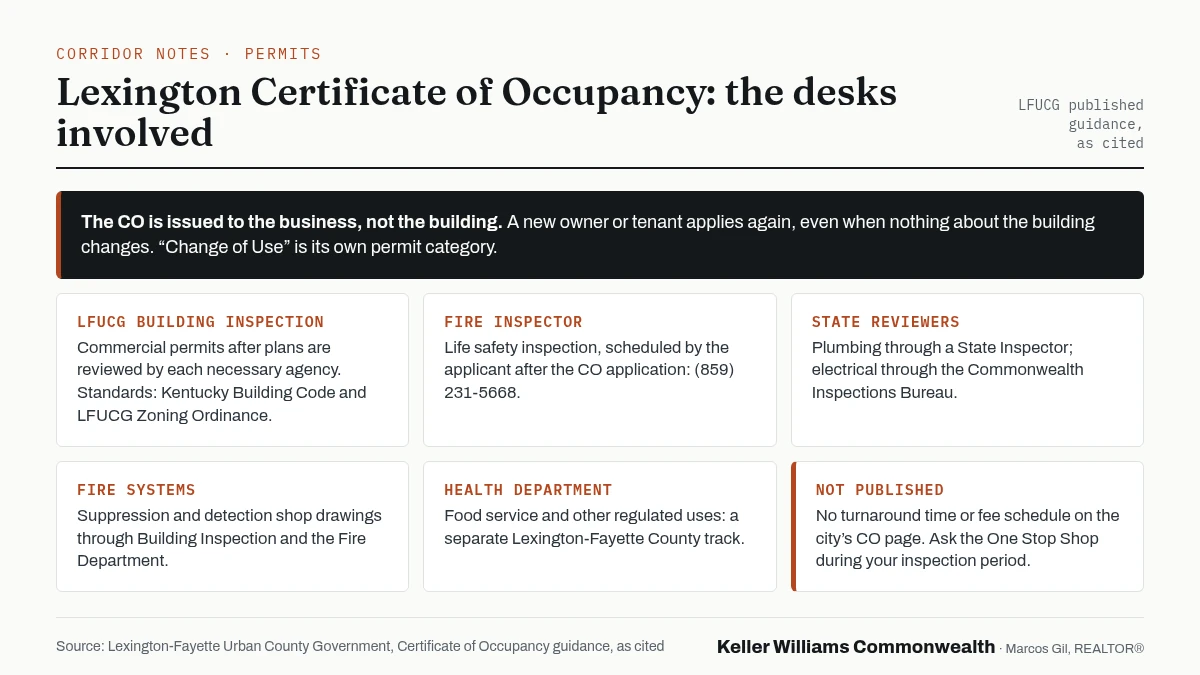
    Card listing the offices involved in a Lexington Certificate of Occupancy: Building Inspection, a Fire Inspector life safety inspection, state plumbing and electrical reviewers, fire systems review and the Health Department, noting the certificate goes to the business and no turnaround is published
    Offices and rules as described in this article from LFUCG’s published guidance.

    That single fact reorders a lot of purchase timelines. A buyer who assumes the paperwork conveys with the deed will plan to close on a Friday and open on a Monday. In practice the application, the review and the required inspection all sit between those two dates, and none of them can start until someone applies. The city’s application route is published at lexingtonky.gov/permits, and its One Stop Shop exists to walk applicants through which track they belong in.

    What Triggers a New Certificate of Occupancy in Lexington?

    Two paths exist, and which one you land in decides whether this is a form or a project. LFUCG’s own guidance splits them this way:

    Your situationWhat LFUCG says applies
    Occupying a space with no change of use, no additions and no remodelingApply directly for the Certificate of Occupancy
    A change of use is occurring, or remodeling is taking placeThe business must apply for a building permit first
    Source: LFUCG, Certificate of occupancy.

    “Change of Use” is not an informal description here — it appears as its own listed permit category on the city’s commercial construction page, alongside new buildings, additions, remodeling, paving, fences, retaining walls, canopies and storage tanks. If your intended use differs from what the building was last approved for, you are in the permit track, and the certificate comes out the far end of it rather than the near end.

    The building conveys at closing. The permission to operate in it does not.

    Who Actually Signs Off — Building Inspection or the Fire Department?

    Both, and they are separate appointments. After the certificate application is made, LFUCG requires the business to schedule a life safety inspection with a Fire Inspector — a phone call the applicant makes, at (859) 231-5668.

    The jurisdictional split goes further than most buyers expect, and it is worth reading before you assume one office can answer everything. On commercial work, LFUCG’s Lexington-Fayette Urban County Government Division of Building Inspection publishes that a permit issues only after construction documents and plans have been submitted, reviewed and approved by each of the necessary LFUCG agencies — and that plumbing review runs through a State Inspector, electrical through the Commonwealth Inspections Bureau, and fire suppression and detection shop drawings through both Building Inspection and the Fire Department. Four different desks, on one project.

    What Standard Is the Building Being Held To?

    Two documents, named on the city’s own page: the Kentucky Building Code and the LFUCG Zoning Ordinance. Building Inspection states that it ensures all new commercial buildings, additions and improvements within Fayette County comply with both.

    The building code half is a statewide document, not a local one — it is adopted and published by the Kentucky Department of Housing, Buildings and Construction, which posts the current adopted editions in full. That matters when you are buying an older building: the standard your intended use is measured against is the code in force now, not the code the building was built under. The zoning half is local, and it is where a use that seems obviously fine can quietly fail — the same problem I wrote about in Economic Development (ED) zoning in Lexington.

    How Long Does It Take?

    Lexington does not publish a turnaround time or a fee schedule on its Certificate of Occupancy page. That absence is itself worth planning around.

    I will not put a number here that the city has not published, and you should be skeptical of anyone who does. What I can tell you as a matter of professional practice is that the variable is almost never the certificate itself — it is how many of those separate reviews your project triggers, and how quickly the third-party inspections get scheduled. A tenant walking into a space that was already approved for the same use is a different exercise entirely from a buyer converting one. If your business plan depends on being open by a specific date, the honest move is to call the One Stop Shop during your inspection period and ask which track your intended use falls into, before the diligence clock runs out. The commercial property inspection period is the right window for that question, and converting retail space to a restaurant is the version of this problem where the stakes are highest.

    The city’s published guidance on all of this sits on one page: LFUCG Certificate of occupancy.

    Questions Buyers Ask

    Can I get a certificate of occupancy before I close?

    The certificate is applied for by the business that will occupy the space, so the practical question is whether you have the seller’s cooperation and enough access during your diligence period to get the application and inspection moving. That is a term to raise with your agent and your attorney while the contract is still being written, not after.

    What counts as a change of use?

    LFUCG lists “Change of Use” as a permit category on its commercial construction page but does not define the boundary case by case there. If your intended operation differs from what the space was last approved for, treat it as a change of use until the city tells you otherwise — and confirm with Building Inspection rather than assuming.

    Do I need a separate health department permit?

    For food service and several other regulated uses, yes — the Lexington-Fayette County Health Department runs its own permitting track, separate from LFUCG’s. It is one more desk to add to the sequence if your use touches food, water or public accommodation.

    Last updated: August 28, 2026

    By Marcos Gil, REALTOR® — Keller Williams Commonwealth · KY Real Estate License No. 296259 · Call or text (859) 310-1209.

  • Economic Development (ED) Zoning in Lexington, KY

    Corridor Notes · Zoning & Land Use

    Economic Development (ED) zoning in Lexington, KY is not a general commercial district scattered around Fayette County. It is an Expansion Area zone. It exists on land Lexington brought inside its Urban Service Boundary, and its rules sit in a different article of the zoning ordinance from the B-1, B-4 and I-1 districts most buyers already know. So when a listing says “zoned ED,” those two letters tell you where the parcel sits in Lexington’s growth history — and which master plan it has to answer to — before they tell you anything about what you can build.

    What is Economic Development (ED) zoning in Lexington?

    ED is a Lexington zoning district that sets aside Expansion Area land for employment uses, and it is governed by the Expansion Area Master Plan rather than by the ordinary commercial districts.

    That is not a paraphrase of the intent — it is close to the ordinance’s own framing. The Economic Development Zone appears at Section 23A-10 of the Lexington-Fayette County Zoning Ordinance, and the stated purpose of the zone is to provide land within the Expansion Area for employment opportunities compatible with the overall character of development set out in the Expansion Area Master Plan. The section also requires that development in the ED zone comply with the Community Design Element of that master plan.

    The ordinance itself is published by the city. You can reach the current text through the Lexington-Fayette Urban County Government Zoning Ordinance page, which links to the full hosted code; the ED zone is Section 23A-10 within Article 23A. Verified on the city’s own site on August 27, 2026.

    The practical consequence is the part buyers miss. Two Lexington parcels can both be described as “commercial land,” sit two miles apart, and be reviewed against entirely different documents — one against the general zoning districts, the other against a master plan written for the Expansion Area. Same city, same ordinance book, different chapter of the rulebook.

    Why does ED zoning only exist inside the Expansion Area?

    Because ED is an Article 23A district, and Article 23A is Lexington’s Expansion Area article. Those zones apply to land added for growth, not to the county’s long-established commercial corridors.

    Article 23A is where Lexington keeps its Expansion Area zones as a set — the Expansion Area Residential districts sit in the same article, at Section 23A-5 and its neighbours. Reading ED in isolation is what causes the confusion. Read it as one district inside an Expansion Area chapter and the logic is obvious: these are the rules the city wrote for land it planned to grow into, and they were written to work together with a master plan rather than on their own.

    That growth question is live right now, which is why this matters more in 2026 than it did a decade ago. Lexington runs an Urban Service Boundary — the line that separates where urban services and higher-density development are allowed from where they are not — and in June 2023 the Urban County Council approved an expansion of it, reported at the time as the first in nearly 27 years. The city then had to write a plan for the added land.

    The June 2023 council vote was covered by WKYT on June 3, 2023. The city’s follow-on planning work — the document intended to guide development, land use and transportation across the new areas — is published as the Urban Growth Master Plan, and LFUCG has run public input on the Urban Service Boundary expansion draft designs. All three links verified on August 27, 2026.

    ED is the only Lexington commercial zone that tells you as much about when the land came into the city as it does about what you can build on it.

    What should you verify before you buy ED-zoned land in Lexington?

    Verify five things, in this order: the parcel’s actual zoning, the Section 23A-10 use list, the applicable master plan, the design requirements, and the service availability.

    Every one of these is answerable from public sources before you spend a dollar on a contract. None of them requires a consultant. The table below is the sequence I would work through, and where each answer actually lives.

    What to confirmWhere the answer livesWhy it matters
    The parcel is genuinely zoned EDLFUCG Planning — the official zoning map and parcel recordListing copy is marketing, not a zoning determination
    The permitted and conditional use listSection 23A-10 of the Zoning OrdinanceDo not assume general commercial uses carry over into an Expansion Area zone
    Which master plan governs the parcelThe Expansion Area Master Plan; the Urban Growth Master Plan for newer areasED development is reviewed against a plan, not the ordinance alone
    The Community Design Element requirementsThe Expansion Area Master Plan’s design elementCompliance is required by the ED section itself, and it shapes site cost
    Sewer, water and road service to the parcelLFUCG and the relevant utility providersInside the boundary is not the same as served today

    If you want the wider picture of how Lexington’s ordinary business and industrial districts behave, that is a separate question with a separate answer — our Lexington zoning guide walks through the B, P and I districts. And if you are shopping ED-zoned ground specifically, it will show up alongside everything else on our commercial land for sale in Lexington page.

    How does ED zoning change what a parcel is worth to a buyer?

    It changes who the parcel is worth something to. ED narrows the buyer pool toward employment users, and a narrower pool is a different pricing conversation.

    I want to be careful here, because this is exactly the point where people want a number and there is no honest number to give. What I can say is structural rather than numerical: a district written to deliver employment uses is not a district written to deliver whatever the market wants next year. That is a constraint, and constraints cut both ways. They protect the character a master plan was written to protect, and they remove some of the exit options a general commercial zone would have left open. Which of those two matters more depends entirely on why you are buying — and that is a conversation about your plan, not about the zone.

    The same reasoning applies on the other side of town, where the pressure is coming from existing corridors rather than new ground — I wrote about that in the piece on what Hamburg East means for nearby commercial owners.

    A note from working these deals

    In my experience the zoning mistakes that actually cost money are never the exotic ones. They are the ordinary assumption that a letter code means the same thing everywhere in the city. Somebody reads “Economic Development,” hears a friendly phrase about jobs and growth, and files it mentally next to “commercial.” Then the use list turns out to be narrower than the phrase suggested, or a design element adds cost nobody priced. Twenty minutes in the ordinance text and the applicable master plan, before an offer rather than after, is the cheapest due diligence available on a Lexington commercial parcel. It is free, it is public, and it is the step people skip because it feels like homework.

    Is an ED zone the same thing as an Opportunity Zone or a tax-incentive district?

    No, and this is the most common mix-up. ED is a land-use district in the Lexington-Fayette County Zoning Ordinance — it controls what may be built and how. Opportunity Zones are a federal tax designation and control nothing about land use. A parcel could be in one, both or neither, and knowing that a parcel is in an Opportunity Zone tells you nothing about whether your intended use is permitted there.

    Can I put retail or a restaurant on ED-zoned land in Lexington?

    Read Section 23A-10 before you assume so. The ED zone was written around employment uses, and some familiar commercial uses are treated differently there than they would be in a general business district — including limits on how certain service and food uses may operate. That is a use-list question with a written answer, so get the answer from the ordinance text for the specific parcel rather than from the general phrase “commercially zoned.”

    How do I find out whether a specific Lexington parcel is zoned ED?

    Go to LFUCG’s planning and zoning resources and look the parcel up directly rather than relying on a listing description. The city’s development and zoning section is the entry point for the official zoning information. If the parcel is under contract, make the zoning verification an explicit step in your due-diligence period rather than an assumption carried over from the marketing package.


    Last updated: August 27, 2026

    By Marcos Gil, REALTOR® — Keller Williams Commonwealth · KY Real Estate License No. 296259 · Call or text (859) 310-1209.

  • Medical Office Space Lexington KY | Buyer’s Checklist

    Corridor Notes · Medical Office

    Medical office space in Lexington, KY does not behave like ordinary office space. It clusters around hospital campuses, it carries build-out requirements a general office never has, and the zoning question is decided before you ever tour the suite. This is the geography, and the free public tools that let you check a building yourself before you write an offer.

    Where does medical office space cluster in Lexington?

    It clusters around the hospital campuses. Two anchors dominate: the South Limestone area downtown, and the Nicholasville Road corridor south of New Circle.

    Those anchors are not a matter of opinion — they are published addresses. UK HealthCare Good Samaritan Hospital lists its location as 310 S. Limestone, Lexington, KY 40508. Baptist Health Lexington lists 1740 Nicholasville Road, Lexington, KY 40503. Both addresses were verified on the organizations’ own sites on August 26, 2026. Draw a short radius around each and you have mapped most of the practical demand for medical suites in Fayette County.

    That matters because the two clusters are not interchangeable. Downtown stock near South Limestone tends to be older, denser, and tighter on surface parking. The Nicholasville Road corridor carries more purpose-built suburban medical product with larger lots. A buyer who is indifferent between the two is usually a buyer who has not yet worked out where their patients actually come from.

    Why does hospital adjacency matter more than the building itself?

    Because a medical tenant’s convenience is measured in minutes to the hospital, not in finish quality. Adjacency is the one attribute a renovation cannot add later.

    You can replace flooring, re-zone a waiting room, upgrade an HVAC system and repaint a facade. You cannot move a building closer to a campus. When a practice weighs two suites, the one that shortens a physician’s trip between rounds and clinic tends to win even when it is the plainer building. For an investor, that is the durable part of the asset — and it is also why medical suites in these pockets tend to trade differently from the general office inventory covered on our Lexington office space page.

    You can renovate almost anything about a medical office except its distance to the hospital.

    What should you verify before you make an offer?

    Verify permitted use, nearby development, flood exposure and assessed ownership. Lexington publishes all four for free, and each takes minutes.

    Most buyers ask the listing agent these questions and stop there. The public record answers them faster and without a filter. This is the sequence I work through before an offer goes out:

    QuestionWhere the public answer lives
    Is a medical use actually permitted in this zone?The LFUCG Zoning Ordinance text
    What is being built or rezoned near this block?LFUCG’s development activity map
    Is any part of the parcel in a mapped floodplain?LFUCG floodplain and flood management
    Who owns it, and what is it assessed at?Fayette County PVA
    What permits have been pulled on the building?LFUCG building permits

    The LFUCG Zoning Ordinance is published in full and is the document that decides whether a clinical use is permitted on the parcel. Lexington also publishes an AgencyCounter development activity map showing development activity across the city and county, and maintains floodplain and flood management information for Fayette County. Ownership and assessment records come from the Fayette County PVA, and permit information is handled through LFUCG building permits. All five were reachable on August 26, 2026.

    Run those five before you tour a second time, not after you are under contract. If the zoning answer is wrong, nothing else on the list matters. Our Lexington zoning guide covers how the district categories fit together.

    How is a medical build-out different from a standard office?

    Medical space needs plumbing distributed to many small rooms, heavier electrical and HVAC provision, wider circulation for accessibility, and far more parking per square foot.

    A general office is mostly open floor with plumbing concentrated in a core. A clinic is the opposite: sinks in most exam rooms, dedicated rooms with specialised requirements, sterilisation and storage, and corridors sized for wheelchairs and gurneys. Imaging adds shielding requirements that dictate wall construction. Each of those is a reason a “convertible” office suite may be far more expensive to adapt than its asking price suggests.

    Parking is the constraint buyers underestimate most often. A practice running several providers with staggered appointments generates a far heavier peak parking load than an equivalent square footage of professional office. On a tight downtown lot, that constraint alone can rule a building out — which is why the parking count belongs in your first walkthrough, not your due-diligence period.

    A note from working these deals

    In my experience the medical office conversations that go badly are almost always the ones where the use question got answered casually. Somebody says “it’s an office building, a clinic is an office” and everyone nods. Zoning ordinances do not work that way, and neither do build-out budgets. I would rather spend twenty minutes in the ordinance text and the development map at the start than discover a permitted-use problem three weeks into a contract. It costs nothing to check, and it is the single cheapest piece of due diligence available on a Lexington commercial property. The broader sequence is laid out on our commercial due diligence page.

    Is medical office space a good investment in Lexington?

    It depends entirely on the specific parcel, its zoning, its parking and its distance to a campus. I can’t promise a return on any property, and Kentucky license law does not allow anyone to. What I can tell you is that hospital adjacency is the attribute that cannot be renovated in later, so it deserves the most weight in your analysis.

    Can I convert a regular office suite into a medical office in Lexington?

    Sometimes, but it is a zoning question first and a construction question second. Check the permitted uses for the parcel’s district in the LFUCG Zoning Ordinance before you price any build-out. Then price the plumbing, electrical, HVAC and accessibility work, which is normally where a conversion budget goes over.

    Where can I see what is being built near a Lexington property?

    LFUCG publishes the AgencyCounter development activity map, which shows development activity across Lexington and Fayette County. It is free and public, and it is the fastest way to find out whether a competing medical building or a traffic-changing project is planned near the block you are considering.


    Last updated: August 26, 2026

    By Marcos Gil, REALTOR® — Keller Williams Commonwealth · KY Real Estate License No. 296259 · Call or text (859) 310-1209.

  • Hamburg East: What Lexington’s Last Interstate Corner Means for Nearby Commercial Owners

    Corridor Notes · Hamburg / Winchester Road

    Hamburg East is the mixed-use development going in where I-75 meets Winchester Road (US-60), and most of the coverage has been written for people who might lease space there. This is the other half of the story: what a project of this size does to the Lexington commercial property you already own a half-mile down the corridor. The short version is that the interchange is being re-priced by its neighbours, not by its own dirt — and the owners who understand which of their attributes just became scarce will read the next three years very differently from the ones who only read the headline.

    What exactly is Hamburg East?

    Hamburg East is Cowgill’s 86-acre Economic Development-zoned project at 2550 Winchester Road, with 44 acres remaining, adjoining Baptist Health Hamburg and the UK HealthCare campus site.

    The Cowgill leasing page states the site corners I-75 and US-60, carries Economic Development (ED) zoning, has visibility from I-75, and sits on a stretch with “nearly 100,000 ADT” — average daily traffic. It also says infrastructure was to be completed by the end of 2024 and master planning by early 2025, and that ground leases are available. Those are the developer’s published figures, and it is worth knowing they come from the party selling the space.

    The independent reporting fills in the rest. Smiley Pete Publishing reported on 5 February 2024 that the 44-acre plot at the I-75/64 and Winchester Road intersection would include restaurants, hotels, apartments, retail and green space, and that an adjacent 41-acre parcel had been acquired from Cowgill by the University of Kentucky the previous September for a new medical facility. The same report names the project as the last available corner for development on the Fayette County interstate system inside the Urban Services Area — which is the single most important sentence in the entire announcement, and the one nobody has written about from an owner’s side.

    FactFigureSource
    Total development86 acresCowgill leasing page
    Acreage remaining44 acresCowgill leasing page
    Address2550 Winchester Road, Lexington, KYCowgill leasing page
    ZoningEconomic Development (ED)Cowgill leasing page
    TrafficNearly 100,000 ADTCowgill leasing page
    Adjacent UK parcel41 acres, acquired September 2023Smiley Pete, 5 Feb 2024
    Planned usesRestaurants, hotels, apartments, retail, green spaceSmiley Pete, 5 Feb 2024

    Why does “the last interstate corner inside the Urban Services Area” matter if you already own nearby?

    Because interstate-visible commercial land inside Lexington’s growth boundary is a fixed inventory, and this project consumes the last uncommitted corner of it on the Fayette County system.

    Lexington-Fayette County has run a hard urban growth boundary for decades, and unlike most American metros, land outside it does not simply become commercial when demand arrives. The city’s own Urban Growth Master Plan page records that in 2023 the Planning Commission recommended a 2,800-acre expansion of the Urban Service Boundary in five locations across Fayette County, and that the resulting master plan was adopted on 30 October 2024 as an element of Imagine Lexington 2045.

    Read those two facts against each other. There is new acreage coming inside the boundary — but “inside the boundary” and “on an interstate corner with 100,000 cars a day and a hospital campus next door” are not the same commodity, and the expansion areas were selected on planning criteria, not on interchange access. If you own a commercial parcel on Winchester Road today, the attribute that just got scarcer is not square footage. It is proximity to an interchange that is now fully spoken for. Whether any of the five expansion areas eventually produces a comparable corner is a question the adopted plan text can answer, and it is worth an hour of your time to read it rather than assume either way.

    A hundred thousand cars a day do not lift every parcel on the corridor. They lift the parcels a driver can actually turn into.

    What does Economic Development zoning next door actually change for you?

    It widens the range of uses that can appear at your fence line, which changes your traffic patterns, your tenant competition and your buyer pool — often before any building goes up.

    Cowgill describes the ED zone as allowing “a wide variety of uses that will serve to support and enhance the wellness community.” That is a developer’s framing of real flexibility, and flexibility next door cuts both ways for an existing owner. A neighbouring parcel that can host medical office, hospitality, retail and residential is a parcel that can eventually compete with whatever you lease, or complement it. Which one it does depends on your own permitted uses, not theirs.

    The practical step is unglamorous and almost nobody does it: pull your own zone’s permitted-use list from the Lexington-Fayette Urban County Government Zoning Ordinance and read it beside what ED permits. If your parcel is B-1 or B-6P and the neighbour can do things you cannot, you have just learned something about your own repositioning ceiling. Our Lexington commercial zoning guide walks through how the common business and industrial zones differ.

    Does a hospital campus next door help or hurt an existing commercial property?

    It changes the daytime population and the tenant mix. It does not automatically raise your value, and treating it as a guaranteed uplift is how owners overprice.

    Two health systems now anchor this interchange: Baptist Health Hamburg is already operating adjacent to the site, and the University of Kentucky holds the 41-acre parcel for a medical facility. Campuses of that kind bring shift-based daytime traffic, a demand for food and convenience within a short drive, and — over a longer horizon — medical office tenants who want to be near referral sources. Those are real, durable demand drivers.

    They also bring a lot of purpose-built new supply into the same submarket at the same time. A twenty-year-old strip centre a mile away does not automatically become a medical-office candidate because a hospital opened; it becomes one if its parking ratio, floor plate, and access can support it. I cannot tell you what your building will be worth, and Kentucky licensing rules mean no agent should be promising you a return. What I can tell you is that the question worth answering is a physical one about your own asset, not a directional one about the neighbourhood.

    What should a nearby owner actually do in the next twelve months?

    Four things, in order: check your assessment, re-time your lease renewals, understand the ground-lease competition, and get honest about your access.

    • Watch your assessment. Large adjacent development eventually shows up in comparable sales, and property tax follows assessed value. The Fayette County Property Valuation Administrator publishes assessment records and the appeal calendar; knowing your number before the notice arrives is the whole game.
    • Re-time your renewals. If you have leases rolling in the same window that Hamburg East delivers its first phases, you are negotiating against brand-new space. Rolling a renewal earlier or later than the crowd is a lever most owners forget they hold.
    • Understand ground leases. Cowgill’s page says ground leases are available. Ground-leased pads change what a competing user has to spend to open near you, which changes who your realistic tenant prospects are.
    • Be honest about access. Traffic count is not the same as capture. If a driver cannot make a safe turn into your site from the direction the new traffic comes from, high ADT is somebody else’s asset.

    In my own practice, the pattern I see after any large announcement is the same: owners either freeze, or they list immediately because they assume the news is already priced in. Both are reactions to a headline rather than to a parcel. The useful work in the months after an announcement is dull — reading the ordinance, pulling the assessment history, walking the site at 8am and 5pm to see how traffic actually behaves at your curb cut. That work is where the difference between two neighbouring parcels shows up, and it is available to any owner willing to do it.

    For the wider corridor picture, see our Hamburg commercial real estate overview and the Winchester Road corridor profile, or compare the two retail spines directly in Hamburg vs. Nicholasville Road.

    Frequently asked questions

    Is Hamburg East built yet?

    The developer’s leasing page describes the project as “coming soon” and states that infrastructure was to be completed by the end of 2024 with master planning completed in early 2025, and that 44 of the 86 acres remain. Delivery of individual buildings depends on the tenants and users who commit to each pad, and that timeline is not published. Confirm current status directly with the developer before making a decision that depends on it.

    Will Hamburg East raise property values on Winchester Road?

    Nobody can tell you that, and under Kentucky law an agent should not be promising it. What can be said factually is that the project adds a large amount of new commercial and residential supply and two medical anchors to one interchange at once. Whether that is net positive for a specific parcel depends on that parcel’s zoning, access, and condition — which is a question you can answer with public records rather than speculation.

    What is the Urban Services Area and why does it matter to commercial buyers?

    It is the boundary inside which Lexington-Fayette County provides urban services and permits higher-density development. Because the boundary is enforced rather than advisory, commercially usable land inside it is a finite inventory rather than an expandable one. The city’s Urban Growth Master Plan page documents the 2,800-acre expansion recommended in 2023 and adopted in October 2024 as part of Imagine Lexington 2045.

    Last updated: 25 August 2026

    By Marcos Gil, REALTOR® — Keller Williams Commonwealth · KY Real Estate License No. 296259 · Call or text (859) 310-1209.

  • How Toyota’s Georgetown Plant Is Shaping Lexington’s Industrial Market

    Corridor Notes · Industrial Real Estate

    Toyota’s Georgetown plant is the single largest employer feeding demand into Lexington industrial real estate, and its scale sets the floor for how buyers should think about industrial land and buildings along the I-75/I-64 corridor north and east of the city.

    Last updated August 24, 2026.

    How Big Is Toyota’s Georgetown Plant, and Why Does It Matter for Lexington Industrial Real Estate?

    Toyota Motor Manufacturing, Kentucky in Georgetown employs roughly 10,000 people and is Toyota’s largest vehicle manufacturing plant in the world, with capacity to build about 550,000 vehicles and more than 600,000 engines a year, backed by more than $11 billion invested in the site since it broke ground in 1986, according to Toyota’s own facility profile. A plant that size does not run in isolation — it pulls in a tier of parts suppliers, logistics providers, and tooling shops, and a meaningful share of that supply chain looks for industrial space in the Lexington-Georgetown-Winchester triangle rather than inside Georgetown itself, where land near the plant is largely built out.

    Which Lexington-Area Industrial Corridors Feel Toyota’s Supply Chain Most?

    The corridors that see the most Toyota-adjacent industrial interest are the ones with direct highway access to Georgetown: North Broadway and the I-75 interchanges, and the Winchester Road corridor running toward I-64. Both put a supplier within a short truck run of the plant while still pricing well under Scott County’s built-out industrial parks. Our Winchester Road Corridor page tracks what’s currently listed along that stretch, and the broader industrial and warehouse property page rounds up inventory across the rest of the market.

    A 10,000-employee plant doesn’t need to be inside your fence line to move your industrial listing — it just needs to be a short, predictable drive away.

    Is Toyota’s Growth a Reason to Buy Industrial Property Near Lexington Now?

    Toyota’s scale is a real, ongoing demand driver, but it is not a guarantee of future appreciation or rental income for any specific property — that depends on the site, the building, and the lease in front of you. If you’re evaluating a purchase, get the specifics on financing structure and timeline right first; our commercial financing overview walks through how these deals typically get funded. I’m a real estate agent, not a lender, so any financing conversation should also include your bank or a commercial loan officer.

    In my own conversations with industrial buyers over the past year, the ones who move fastest on Winchester Road and North Broadway listings are usually suppliers or logistics operators who already run trucks to Georgetown and know their drive time down to the minute — they’re not speculating on Toyota, they’re solving a routing problem they already have. That’s a different buyer than someone betting purely on the plant’s headline numbers, and it’s worth knowing which one you are before you make an offer.

    What About Air Cargo and the Rest of the Supply Chain?

    Georgetown sits about 90 minutes north of Lexington via I-75 from Cincinnati/Northern Kentucky International Airport (CVG), which some Toyota-linked suppliers use for time-sensitive parts and international shipping. That’s a secondary factor next to plant proximity itself, but it’s part of why logistics and light-industrial tenants sometimes weigh a Lexington-area site against one closer to CVG.

    FAQ

    What does Toyota manufacture at its Georgetown, Kentucky plant?

    Toyota’s Georgetown plant builds the Camry Hybrid and RAV4 Hybrid along with four-cylinder and V-6 engines, per Toyota’s facility profile.

    How many people work at Toyota’s Kentucky plant?

    Toyota reports roughly 10,000 full-time employees at the Georgetown facility, making it the company’s largest plant worldwide by employment.

    Where can I see current industrial listings near Toyota’s Lexington-area supply chain?

    Start with our industrial and warehouse property page and the Winchester Road Corridor page, or call or text (859) 310-1209 and I’ll pull current inventory for your criteria.

    By Marcos Gil, REALTOR® — Keller Williams Commonwealth · KY Real Estate License No. 296259 · Call or text (859) 310-1209.

  • How Fayette County Assesses and Taxes Commercial Property

    How Fayette County Assesses and Taxes Commercial Property

    Corridor Notes · Taxes & Closing Costs

    Fayette County assesses commercial property at 100% fair cash value every January 1, mails reassessment notices in April, and closes its inspection-period appeal window by statute in mid-May — miss that window and your value is locked for the tax year.

    That cycle matters most to commercial buyers and owners at two moments: when a reassessment notice lands and looks wrong, and at closing, when nobody has actually confirmed who is on the hook for the current year’s bill. Below is how the Fayette County Property Valuation Administrator (PVA) actually runs the process, sourced directly to the PVA’s own appeals page and the Kentucky Department of Revenue’s statewide property tax calendar.

    What Standard Does Fayette County Use to Value Commercial Property?

    Fayette County values commercial property at 100% Fair Cash Value, the standard the Kentucky Constitution requires for all taxable property unless it’s specifically exempted. The PVA Office determines that value — it does not set tax rates or collect payments; those come from the Commonwealth, Lexington-Fayette Urban County Government, Fayette County Public Schools, and other taxing districts layered on top of the PVA’s assessed value.

    “Fair Cash Value is the most probable sale price in a competitive and open market, with a knowledgeable and willing buyer and seller.”

    When Does the Annual Assessment and Appeal Cycle Actually Happen?

    The assessment date for every parcel in Kentucky is January 1 of each year, per the Kentucky Department of Revenue’s statewide property tax calendar. Fayette County typically mails reassessment notices — including a map of recent comparable sales in the property’s neighborhood — in April, and the statewide tax roll inspection period runs 13 days starting the first Monday in May.

    For the 2026 tax year, Fayette County’s open inspection period ran through Monday, May 18, 2026; a PVA conference had to happen before that date, and an unresolved dispute had to be filed with the Fayette County Clerk’s Office for the Local Board of Tax Appeals no later than Wednesday, May 20, 2026, under KRS 133.045. The exact dates shift slightly year to year, so confirm the current window directly with the PVA each spring rather than assuming last year’s dates repeat.

    Who Owes the Tax Bill When a Commercial Property Sells Mid-Year?

    Under Kentucky’s property tax calendar, the person who owned the property on January 1 of the tax year is the owner of record for that year’s bill — even if the property changes hands in June or October. The buyer and seller can privately agree in the purchase contract to prorate that expense at closing, but that proration only happens if the contract explicitly says so; otherwise the legal obligation for the full year’s bill stays with the January 1 owner.

    In my experience walking Lexington-area commercial buyers through closing, the property tax proration line on the settlement statement is one of the most commonly misread items on the whole sheet. Buyers often assume the figure is based on the current year’s reassessed value, when in reality Fayette County’s reassessment notices don’t go out until April — well after many spring closings have already happened — so the proration is frequently built off the prior year’s certified value instead. I make a habit of asking the closing attorney directly which year’s assessed value the proration actually uses before anyone signs.

    What Evidence Does the Fayette County PVA Actually Ask For?

    The PVA publishes its own evidence list: comparable sales, recent appraisals, photographs, insurance policies, construction costs, and listings or contracts on the property.

    That list is worth reading closely, because it is broader than most owners assume. An insurance policy and a construction-cost record are both on it — meaning a commercial owner who overbuilt a build-out, or who is insuring the improvement for less than the county is valuing it, already holds relevant evidence without commissioning anything new. A listing or a contract is on the list too, which matters for a property that sat on the market: an unaccepted asking price is not fair cash value, but a real marketing history is evidence about what the market would actually pay.

    The Fayette County Property Valuation Administrator also describes the conference as a conversation, not a filing. Its published instruction is that a property owner must speak with a designated PVA staff member by the deadline, and that all conferences must be held before the open inspection period ends. A form submitted on the final afternoon without that conversation is the failure mode to avoid — the conference is the step that preserves the next stage of the appeal.

    One more number that shapes expectations: Fayette County is divided into roughly 300 assessment areas the PVA calls “PVA Neighborhoods,” each reviewed and typically reassessed every three to four years under a Kentucky Department of Revenue quadrennial plan. If your commercial parcel sits in a neighborhood that was last touched three years ago, a notice is more likely than not in the near term, and that is worth modeling before you buy rather than after.

    Do Business Equipment and Fixtures Follow the Same Appeal Path?

    No. Tangible personal property runs an entirely separate track — a written protest filed directly with the Department of Revenue within 45 days of the notice, not a May conference with the county PVA.

    This catches commercial buyers regularly, because a building purchase and an equipment purchase often close in the same transaction and then diverge completely at assessment time. Per the PVA’s published guidance, personal property taxpayers are served notice under KRS 132.450(4) and hold the protest and appeal rights granted under KRS 131.110. The taxpayer lists under protest what they believe the fair cash value of the property to be, files a written protest directly with the Department of Revenue, Office of Property Valuation within 45 days from the date of the assessment notice, and may then appeal the Department’s final decision to the Kentucky Board of Tax Appeals.

    Read that sequence against the real property one and the practical difference is stark. Real property: an April notice, a conference with the Fayette County PVA, a mid-May deadline, then the Local Board of Tax Appeals through the County Clerk under KRS 133.045. Personal property: a notice on its own clock, a written protest to Frankfort, 45 days, then the state board. Different deadline, different office, different filing. Confirm your own dates and requirements with the PVA and with your CPA or tax attorney — this is a description of the published process, not tax advice.

    Frequently Asked Questions

    Does a higher assessment automatically mean a higher tax bill?

    Not directly. Your bill is the assessed value multiplied by the tax rates set separately by the Commonwealth, LFUCG, Fayette County Public Schools, and other taxing districts — the PVA Office sets the value but has no role in setting those rates.

    Can I appeal a commercial property assessment without hiring an attorney?

    Yes. An initial conference with the PVA Office doesn’t require a paid representative. If you do use one, Fayette County requires a signed letter of authorization from the property owner before the PVA can discuss the assessment with them.

    How often is Fayette County commercial property reassessed?

    Neighborhoods are reviewed on a rotating basis, typically every three to four years, under a Kentucky Department of Revenue quadrennial plan — though a specific parcel can be reassessed sooner if there’s a qualifying change, like new construction or a recent sale.

    I bought the building in July — when is my first chance to protest the value?

    Generally the following year’s cycle. Because the assessment date is January 1 and the inspection period closes in mid-May, a buyer who closes in summer or fall inherits a value that was set and became final before they owned the property. Plan on the next spring’s notice being your first real opportunity, and confirm the current window with the PVA Office.

    Related Reading

    If you’re weighing how a reassessment affects a deal already under contract, see how closing timelines and recording work in Kentucky, how we approach commercial property valuation ahead of a listing or purchase, and whether a 1031 exchange changes your tax-planning timeline on a sale.

    Last updated: September 10, 2026

    By Marcos Gil, REALTOR® — Keller Williams Commonwealth · KY Real Estate License No. 296259 · Call or text (859) 310-1209.